Catching late autumn leaves in Kyoto – without crowds

Last year I found myself with some unexpected days off at the beginning of December. Some leave I had to take in 2025, or it would be voided. Not the ideal time to travel, so short before the Christmas season, and for us, flu season keeping us busy, I didn’t want to gift my precious time off to my corporate employer, either, so… I booked a flight to Osaka.

We had just been on a trip to Tohoku, our main holiday for the year, and admired plenty of autumn scenery with the famous multicolour leaves – Japan is mostly mountains, and there are plenty. And, this being Tohoku, there were no crowds, except for the Saturday we spent in Nikko.
Heading to my favourite Japan destination, Kyoto, just like the year before, I may not have hit the spot for peak autumn colour, but I had a great time. The year before, travelling around mid-November, I as a little early for Kyoto’s peak colours. This time, I was late – but there were some exceptions.
You may not always be able to plan your trip at the peak of autumn colours – and there are clear advantages to being a little late. The most important one – crowds drop sharply after the last weekend of what is considered ideal for autumn leaves, usually five to ten days into December.
In this post I am going to share some more wonderful Kyoto autumn sports that fly a little under the radar, which do not get tons of visitors, and which peak a little later than most Kyoto autumn leaves sites. This was a repeat visit, so I did see some of the UNESCO World Heritage Sights of Kyoto on earlier trips. This one focuses on late autumn leaves in Kyoto.

When I arrived on Saturday, December 6 in 2026, which was the last weekend of autumn leaves, with prices to match. I stayed in the dorm of Piece Hostel Kyoto (26 Euro, fabulous and good value given the season) , and changed to the wonderful Gallery Nozawa Inn on Sunday night, where I paid well under 50 Euro per room, with breakfast, and generally enjoyed a crowd-free Kyoto. I got at least five good days of autumn leaves viewing, perusing the calendar and cycling to less crowded places.
Importantly, check the Kyoto Autumn Leaves Calendar. It is updated every few days, and you can see the autumn leaves state from previous years, too. There are so many wonderful temples in Kyoto, there is absolutely no need to go to the most crowded ones.
Table of Contents
Getting to Kyoto
This is the easy part. I normally fly to Kansai International Airport, from where you can catch both a direct train (Haruka Airport Express) as well as a comfy limousine bus to Kyoto. So far, I have always taken the Haruka, since it’s fast and runs every 30 minutes or so, and you can buy a reduced-price ticket on JR West if you are a foreign tourist. The Airport Limousine Bus stops just once, in the outskirts of Kyoto (at Kyo-Tanabe) and takes you to the Southern side of Kyoto Station. At currently 2800 Yen one-way its cheaper than the standard Haruka fare but more than the tourist Haruka fare. It is very convenient if you stay in one of the hotels at Hachijoguchi exit of Kyoto Station, so you don’t have to cross Kyoto Station to Track 30 for the Haruka if you have a lot of luggage.

Where to Stay
I book my accommodation well before my flights, so I had a week booked at one of my favourite places, Gallery Nozawa Inn. With just two rooms, you feel like the personal guest of the retired couple running this historic Kyoto Townhouse as a small guesthouse.

The weekend I arrived, I spent one night in a dorm at Piece Hostel Kyoto. I was very impressed with this hostel which manages to be comfortable and personable, despite its size. It was the last weekend of peak autumn leaves, so accommodations were really expensive, so I resorted to a dorm room – not ideal because I get jet lag, but weekend hotel prices were really prohibitive. I was pleasantly surprised that my small mixed dorm, holding six sleeping cubicles, was very comfortable indeed. The sleeping cubicles were really private and spacious and my roommates were all middle-aged considerate Asians.
I spent the last night before flying home in Downtown Kyoto at Hotel M’s Plus Shijo Omiya. This was some seasonal promotion – 600 Euro for a private en-suite room. I wasn’t expecting much but the location looked good for both my day trip to Osaka on the fabulous Kyo-Garaku Sightseeing Train and for my food and drugstore shopping.
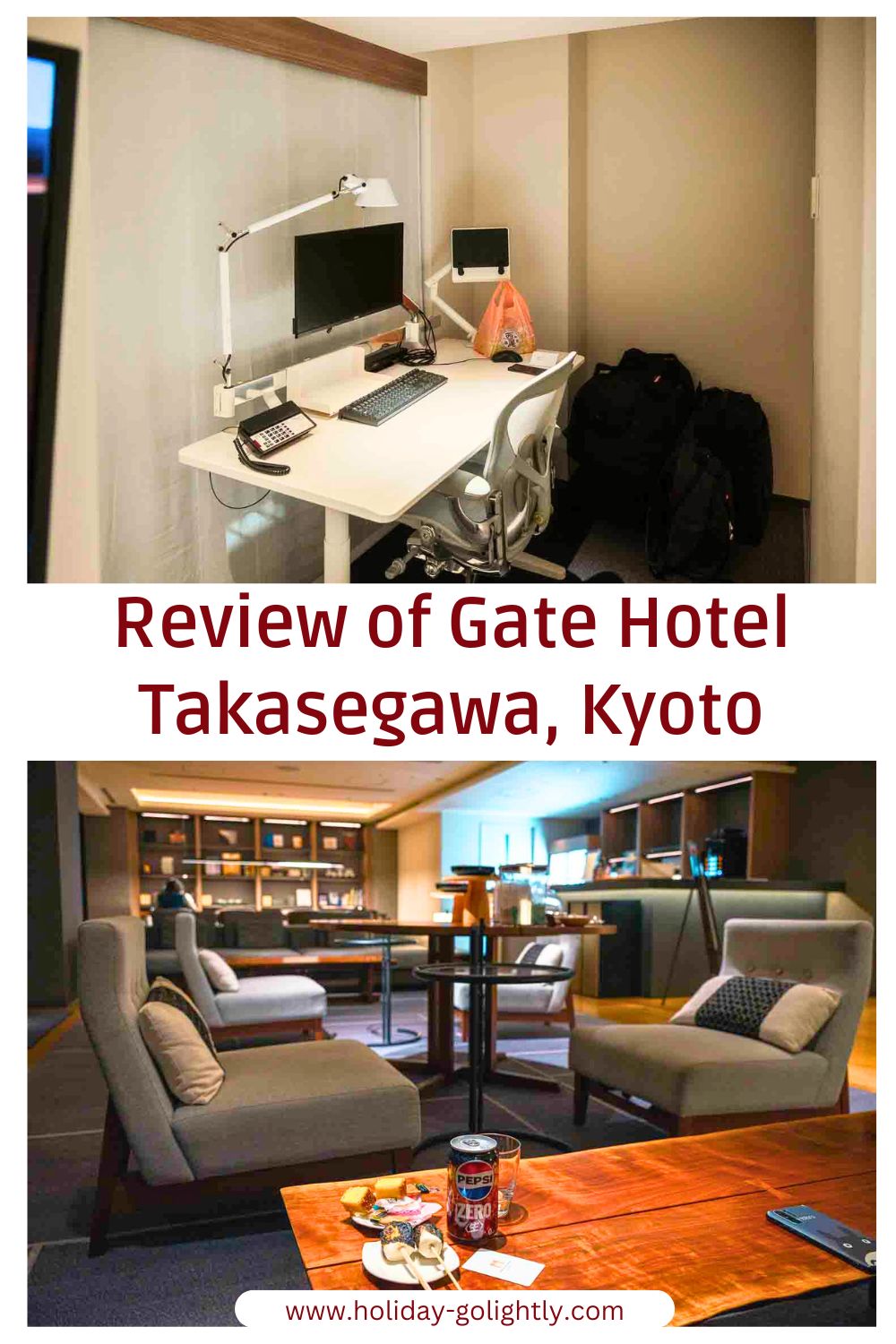
These hotels and hostels reflect my usual budget – mid-range private rooms. For a higher-end hotel, I recommend The Gate Hotel Takasegawa in Pontocho for its cool conversion from a primary school, style and high-end experience. I stayed here in February 2026 and loved it – especially the lounge with its free drinks and snacks, and the really comfortable rooms. They often have promotions – I paid around 120 Euro per night which I am happy to pay for a five-star experience. Location is great -quiet yet 100m away from Kawaramachi, great for your last-minute shopping. Detailed post here.
Mount Takao Temples
I headed to Mount Takao first because I wanted to see Kozan-ji, a small temple in a beautiful forest that holds some early scrolls of Chōjū-jinbutsu-giga, picture scrolls with animals, from the 12th and 13th Centuries.

Thanks to jetlag, I left early and was nearly alone on the bus all the way up Mount Takao. This changed rapidly when I climbed the steps to the temple, where I was joined by Japanese tourists travelling by coach. But they came, they saw, they shopped, and were gone quite quickly, and on the whole, although there were tour groups visiting, I did not find it that crowded. Other than the picture scrolls, the temple has some nice views but I would not call it outstanding in terms of its buildings.

There are some wonderful forest paths, lined with huge centuries-old trees, in the vicinity, so I would advise, take the (faster) stairs up but walk down on the somewhat longer footpath. This will take you to the next mountain temple, called Saimyo-ji, partially along the road, partially along some pretty footpaths.

Saimyoji has a forest setting, too, and barely any visitors. It cannot match the beauty of other Kyoto temples, but I would not miss it. The last of the Mount Takao temples, called Jingo-ji, is, in my eyes, the true star of the three. The approach already is scenic, with the lovely riverside path, lined with inns that operate mostly in summer, and an end-of-season nostalgic atmosphere, then a rather steep long stone staircase to the multi-level temple. The temple’s setting is wonderful – if you can, I would probably visit as early as you can on your trip, and avoid weekends.
Ryoan-ji
Right after Mount Takao, I caught a bus back at lunchtime and decided to try my luck at the traditional Yudofu restaurant of Ryoan-ji. Ryoan-ji is one of my favourite Kyoto Temple,s and although it holds maybe the world’s most famous Zen Garden, it often is not crowded – if you time your visit right. The bus dropped me right at the entrance, and I headed straight through the strolling garden to Seigen-in, the restaurant.

You have to love tofu, because that’s all that will be served here. The setting, overlooking the garden, is gorgeous. The prices – reasonable. I ordered the biggest yudofu meal – simmered fresh tofu and side dishes. You sit on tatami mats in rather traditional style, looking out into the strolling garden. A wonderful experience, but be prepared to sit on the floor on cushions – there are no other options.

Then I strolled around Ryoan-ji’s Garden, and made my way up to the Hondo and its famous Zen Garden. it was relatively late in the day, and this seems to be an ideal time to visit, because there were hardly any people there. I don’t know if it’s fallen out of favour with tour groups, but there were none and after seeing it quite busy during cherry blossom time, it’s best seen like this – quiet. Ryoan-ji remains one of my all-round favourite temples which seems to have it all – landscaped gardens, Zen Gardens, some nice temple buildings – and a bus stop right out front.
Joju-ji and the Katsura Temples
After spending Sunday on Mount Takao, I headed for the Western hills on Monday. Making good progress on my rental bicycle from Shimabara, I was in Katsura within the hour. I always recommend cycling in Kyoto , but you can easily get there by taking a Hankyu train to Kami-Katsura and walk about 10 minutes, or a bus to Saiho-ji from Kyoto Station or Downtown.
I cannot remember where I picked this tip up, but the foliage was stunning and the temple really geared up for visitors – with tours (in Japanese), special sales of goshuincho and special goshuin. It was 100Yen to enter, twice what you pay at most Kyoto temples, but worth it. Also, I appreciate this temple really is off the toursits track so probably appreciates the extra income. You walk through a stunning corridor of orange leaves, and the temple itself, though small, has a nice garden where you can sit for as long as you like on tatami mats.
I then proceeded to Jizo-in Temple. I had been there in summer, when it was sleepy with no one around. This time, the stunning bamboo forest and autumn foliage attracted a few more visitors. It cost 1000Y to enter (for non-residents) and no matter what tine of the year you visit, it is worthwhile and can easily be combined with famous Saiho-ji. The autumn leaves were stunnin geven late in the season, and, I would say, at their peak when I visited. There are a few pleasant well-maintained wooden buildings, and the temple if beautiful for photography. Other than that it is a pleasant, inviting well-maintained Zen Temple.

At last, I ventured to Kegon-ji – I was in two minds whether to visit, but I saw a long queue, and thought, well, this temple must be amazing, let’s queue, too. The queue moved fast and this temple is more famous for the bell crickets that are being kept here (hence its other name, Suzumishidera) and the sermon held every half hour during visiting hours. It was an interesting experience – I understood very little what was going on but the sound of the crickets droning over the priests sermon was… interesting, and it was one of those very Japanese experiences that I did not fully understand. I also got to see the wish-granting Jizo.
Although Arashiyama is close, this area is not touristy at all. I had lunch at a tiny cafe called Cafe de les Amis, run by an elderly couple, and decorated so beautifully. I cycled home along the Katsura river, where people grow vegetables in allottment,s and visited a recycle shop, where I found cheap kimono and other shoppers keen to practuice their English and giving me some good kimono shopping tips. The evening kind of turned into a bit of a shopping trip since there were too many 100Yen-Shops along the rout,e and I felt the compulsion to stop.
Uji
I had been to Uji back in the day… 2008, when not that many tourists visited. Now, it has become famous for the place where you bulk- buy matcha and take a photo of a 10Yen-coin with the backdrop of Byodo-in.
Matcha had been on short supply in 2025, and I wanted to see the matcha craze myself… so I hopped on a local Nara Line train. Thanks to jetlag, I arrived very early, so whatever matcha shops were open were not crowded, and there were no queues. I was beginning to wonder whether all these instagram videos of “matcha haul” were somewhat over dramatizing.

In all honesty, I would make Uji an all-day trip and probably visit Byodo-in first. The Phoenix Hall is accessible by tour only, but the really beautiful view of Phoenix Hall across the poind and the park surrounding it makes this really beautiful. There is also a very good museum on the temple grounds. There are several other temples behind Phoenix Hall, once part of a vast complex.
However, there is a lot more to Uji, and I am not talking about matcha here. Across the river is Kosho-ji, a lovely Zen Temple that gets hardly any visitors – a lot of the temple, including the meditation quarters, are avaiable to view. I really enjoyed that one. Also, especially in autumn, walk up to Uji and Ujigami Shrines – the buildings look like “standard” Shinto shrines, but they are set in a deciduous forest, so stunning autumn colours and no crowds. The cute rabbit-shaped omikuji are an extra bonus. You can then walk back on that side of Uji River, past some cafes, and enjoy more autumn colours before arriving at the Brutalist Keihan Railway Uji Station, or turn back across the river, and spend time tasting and buying matcha.
If you are visiting in summer, Mimuroto-ji is worth a detour, as it has stunning gardens with hydrangea, but many other flowers, too. And, one stop on, Obake Zen Manpuku-ji is a worthwhile one to visit if you are interested in Zen Temples.
For food in Uji, I cannot recommend the restaurant at Fukujuen Uji Tea enough – it is close to Uji Shrine and has a small seasonal menu focusing on matcha soba and matcha desserts. Visited twice now, it’s quiet, and very delicious food. The shop downstairs sells many varieties of tea – including matcha. Other matcha shops I liked where Itoh Kyuemon, Kanbayashi Shunsho and Tsujiri – they are all either on Byodo-in Omotesando or the road leading to JR Uji Station . And yes, I have been to Nakamura Tokichi, too, because I was influenced – but despite the hype, food and matcha were middling.
Konkai Komyo-ji
I headed here, fresh off the plane, on the day I arrived in Kyoto. I had visited the year before, loving both Konkai Komyo-ji and Shinnyo-do. The walk up from Okazaki bus stop is stunning, and even on a Saturday afternoon, there were no crowds whatsoever. However, I was a little late for the best leaves, and I think they peak with most others in Kyoto, or a bit later.

The temples are lovely, especially some of the subtemples, many of which have special openings during autumn leaves season. Walking around the area is lovely, even if you may miss the peak colour – residential with older traditional houses, puncutated by the massive temple Sanmon, affording lovely views across Kyoto and peaceful walking. Okazaki Shrine off Marutamachi-dori is also lovely – and has cute rabbit omamori (charms), omikuji (oracles in a little rabbit figurine) and goshuin.
Kodai-ji
Not an off-the beaten track attraction at all, but I am going to include it here because of its seasonal illuminations. They were stunning! Kodai-ji is a really nice Zen Temple in Higashiyama, and although located at the end of Ninen-zaka, it has a bit of everything – nice strolling gardens, a treasury, a nice Hondo, and a bamboo grove.

Kodai-ji’s illumination events are, however, stunning. And they will only cost you the standard entrance fee of 600 Yen. I’d say the leaves peak with most others, maybe a little later, but even past peak, the gardens and bamboo grove are stunning.

I arrived just before sunset, took in the nicely illuminated Gariyuchi Pond, lined with trees in their autumn colours. Then I took some photos of the tea houses and bamboo grove, before heading back to the Hondo for the projection event at Hashin-tei Gardens. I had visited before, but if it is your first visit, I highly recommend visiting in daylight, too, then hang around until it gets dark. Since it was a weeknight, the main projection event, taking place at the Hondo, was not that crowded, and I was able to see the show several times, sitting quietly at the back… it tells the story of how this temple came into existence, built by Toyotomi Hideoshi’s wife of 40 years after he died, where she subsequently became a nun.
Tenryu-ji and Arashiyama Temples
These will show colours with most of Kyoto’s temples and shrines. Tenryu-ji is a UNESCO World Heritage site and has the hyped bamboo forest as its neighbour, but Arashiyama is a lot more than that.

I admit that despite having been to Kyoto several times, I shied away from Arashiyama, worried it would be too crowded. Well… two weeks past peak colours, when crowds were still streaming towards Tenryu-ji, I turned right at the station exit, and walked to Gio-ji and Shoan-in temples. Gio-ji still had some nice colours – and pretty much no people. Nison-in and Jojakko-ji are temples famous for autumn leaves, and often visited by Japanese visitors, but will be less crowded on weekdays. Daikaku-ji is another large and famous temple – with relatively few crowds, since it’s an extra 15-min walk from the main drag.
My favourite places here were Gio-ji and Shoan-in, for very different reasons. Gio-ji is a small subtemple of Daikaku-ji (Shingon School of Buddhism) and basically a showcase highly naturalistic garden with moss and deciduous trees. Absolutely stunning. It has one small hall and I am not sure whether this temple is still active.
Shoanin, almost directly opposite, is a small one-building very active temple, inofficially dedicated to the art of creating beautiful goshuin. Wherever you look there, there are goshuin and art supplies -and a few lady busy drawing and writing them. They were so sincere, chatting away and offering advice and pasting the goshuin into books, I loved it there. A wonderful atmosphere, and wonderful mementos.
Other Kyoto sites with late autumn leaves
According to last years autumn. leaves calendar, there are plenty of places with peak colours towards the end of the first week of December and well into the second week of December. I just include those I have been to, not necessarily for autumn leave,s and which I would recommend.
Ninna-ji is a large temple and UNESCO World Heritage site a short walk from Ryoan-ji. Absolutely recommend. While the temple is free, pay extra for the Palace Garden. And look out for the seasonal limited edition goshuin of Emperor Uda’s Black Cat – they might be a bit pricey at 1500Yen, but they are works of art! Of course I love cats, so I visit regularly. Talking of cats… Nyan-nyan-ji is a cool place to visit should you head to Renge-ji (famous for autumn leaves, sedate at most times, haven’t been during autumn leaves).

Daigo-ji in Fushimi is another large temple that has late autumn leaves. A bit of a trek to get to, but rewarding, stretching over several levels. If you feel fit, hike through the forest to Kami-Daigo, one of the Saigoku Kannon Pilgrimage temples. This will make an excellent alternative if you love hiking but find Fushimi Inari too crowded. If you have time and energy, Bishamon-do in Yamashina is stunning, with a wide staircase framed by red leaves, but again, peak colour appears earlier than at Daigo-ji.

Last not least, some shrines have wonderful large gardens where crowds disperse easily. Late autumn leaves can be admired at Shimogamo-jinja (UNESCO World Heritage site) and Kitano Tenman-gu. Also, Kyoto Imperial Place Gardens have late autumn leaves, and so do the gardens of Nijo Castle.
Another Shrine that has not made it to the Kyoto Autumn Leaves Forecast is Imamiya Shrine. Maybe it’s not important enough, but it certainly has some very pretty autumn leaves, and gets very few tourists. If you are visiting Daitoku-ji, consider walking the extra five minutes here. Also, one very important argument to pop in here is the charcoal grilled aburamochi at two tea shops, Kazariya and Ichimonya Wasuke – nothing better no a cold day to eat these in their semi-open air cafe washed down with a big pot of green tea.
Other cool things to do
Autumn Leaves are stunning- I feel there is never enough time to admire them, and I will never get tired of them, but towards the second half of my trip autumn leaves were decidedly falling, making some of the temples look a little sad. So I shifted my attention to some other activities.
The first thing I did outside Kyoto’s temples was to join a tour of Harie, the “Village of Springs” at Lake Biwa. The village operates a series of “kabata” , traditional freshwater reservoirs. I easily made a reservation by Email and enjoyed a semi-private tour with a couple from Hongkong, then moved in to Miidera, the “competitor” of Enryaku-ji and one of the stations of the Saigoku 33-Kannon Pilgrimage, and mooched around Otsu a bit.

On the weekend, I finally took the “Kyo-Garaku” Special tourist train between Kyoto and Osaka, operated by Hankyu Railways on weekends. The train is beautiful, but it was quite crowded. You definitely want to get on at the first station, either Kyoto-Kawaramachi, or Hankyu-Umeda. I also don’t think weekends are a great tine to visit central Osaka… it was super crowded everywherme but my quest to try and love Osaka continues. Also, the second hand camera shops of Osaka were a bit disappointing after Tokyo. But hey… I finally got to see Shinsekai, so that was cool.

On my last of the trip, I joined a guided tour of the production facilities at Shoyeido Incense Company in central Kyoto (I link to the US site since the Japanese one doesn’t appear to support https) . This was one of the coolest activities of my trip. The tours are strictly by appointment, and are free, with further information here. I love incense, and the tour was detailed and amazing – including chatting time with the workers at the facility above the Kunjukan Incense Museum in central Kyoto. I happened to be the only visitor on that particular tour, so it was accidentally private, too, and I was granted permission to take a few photographs and chat to the employees.
Of course, I felt compelled to buy more incense after that, but they gifted me some samples, and it is a great intro into Kyoto crafts, if you are interested in aromas and incense.
The Small Print
I visited Kyoto in mid-December in 2026, catching some late autumn leaves (second week of December) and having a great, crowd-free time. The entire trip was paid for my myself, and I was using annual leave to travel.

Nothing you see here was sponsored, and I did not receive compensation, discounts, or special treatment in exchange for writing it. All my own honest and unbiased opinion. This post does contain affiliate links to accommodation I stayed at as well as some good accommodation in the area which I researched and would consider staying at. If you book a hotel using my affiliate links, I may make a small commission at no extra cost to you. Please refer to my blog’s Terms and Conditions for further information.
While my entire blog except this is free from generative Artificial Intelligence, I have been musing whether to bother with pins, and I actually used generative AI in here once, so AI created the last picture.
I am not sure if anyone is still bothering with pins – I feel a lot on Pinterest is AI generated images these days, especially entering “Kyoto Autumn” brings up some wild images. I can even get Canva to make me one for free while I go and brew a cup of tea. It looks bleetingly obvious AI, though, but the colour scheme is rather nice. But I am sorry, you are gonna have to put up with my amateur pins, even though they are more work…


The colors look wonderful, even for early December. It is incredible how many AI pins are being used these days, vs more realistic photos of the destinations.
I love the idea of visiting Kyoto in early December, when the crowds have thinned but there’s still some beautiful autumn color! Joju-ji and its corridor of orange leaves sound wonderful, and I’d definitely want to visit Gio-ji for its peaceful moss garden. Your tip about checking the autumn leaves calendar is especially useful. Sometimes traveling just after peak season turns out to be even better!
How I miss Japan in Autumn! You captured it beautifully and in some very less popular places too, which I love even more! Saving your itinerary so I can add your stops next year!